Categories
Uncategorized

The Lost Archive: France’s Highest Court Should Follow WWII-Era Rejection of Head of State Immunity

This is the link to a Pdf of the memorandum I submitted to the highest court of France referred to in the blog I wrote with Steve Kostas below.

The following post was written by Prof Dan Plesch and Steve Kostas for Just Security

On July 4, 2025, France’s highest court convened in plenary session to hear arguments on whether an arrest warrant against Bashar al-Assad, issued while he was President of Syria, violates head of state immunity. Following the oral arguments, the court announced it would deliver its judgment on July 25, 2025. The international arrest warrant was issued for al-Assad’s alleged role in the infamous August 2013 chemical weapons attacks that killed over 1,400 civilians in Douma and al-Ghouta, Syria. The warrant was issued by French investigating judges in November 2023, following a complaint by survivors and NGOs. While France’s National Anti-Terrorism Prosecutor has challenged al-Assad’s warrant on immunity grounds, the Paris Court of Appeals confirmed its validity in June 2024. The Cour de Cassation’s upcoming decision will address fundamental questions about the scope of immunity for international crimes. One of us (Kostas) is a lawyer who supported Syrian victims and NGOs to build and litigate the case, and the other (Plesch) submitted an expert opinion in the case showing how questions of head of state immunity were addressed over seventy years ago—precedents that have been largely forgotten but should fundamentally inform any analysis of the legal issue.

The ICJ’s Incomplete Foundation

The Prosecutor’s position that sitting heads of state enjoy absolute immunity relies heavily on the International Court of Justice’s 2002 Arrest Warrant judgment, which examined state practice and found “it has been unable to deduce from this practice that there exists under customary international law any form of exception to the rule according immunity from criminal jurisdiction and inviolability to incumbent Ministers of Foreign Affairs, where they are suspected of having committed war crimes or crimes against humanity.” This finding has been widely interpreted as establishing absolute personal immunity for the “troika”—heads of state, heads of government, and foreign ministers—before foreign domestic courts.

However, this interpretation rests on a fundamentally flawed foundation. The ICJ’s analysis did not consider extensive state practice from 1943-1948 that directly contradicts this view—practice that remained classified and largely inaccessible until 2014 due to Cold War-era political pressures.

The Lost Archives and Their Revelations

The missing evidence lies in the archives of the United Nations War Crimes Commission (UNWCC), established in 1943 by sixteen Allied states including France. After World War II ended, geopolitical pressures led to the classification of the entire archive in 1949. Only in 2014, following advocacy efforts, did the U.S. Holocaust Memorial Museum make a complete copy of the UNWCC archives available to the public.

These records reveal a comprehensive rejection of head of state immunity for international crimes that fundamentally challenges conclusions reached in the Arrest Warrant judgment.

State Practice: Hitler’s Indictments While Head of State

The archives document that between November 1944 and April 1945, three Allied states brought detailed criminal charges against Adolf Hitler while he served as Germany’s head of state:

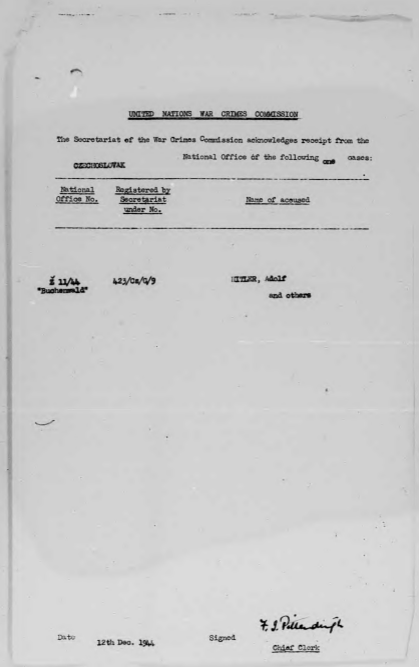
Czechoslovakia filed eleven separate charges covering crimes at Lidice, Dachau, Buchenwald, and Terezin, citing violations of the Hague Conventions and Czechoslovak criminal law. The charges ranged from establishing illegal courts and mass murder to forced labor and systematic terrorism.
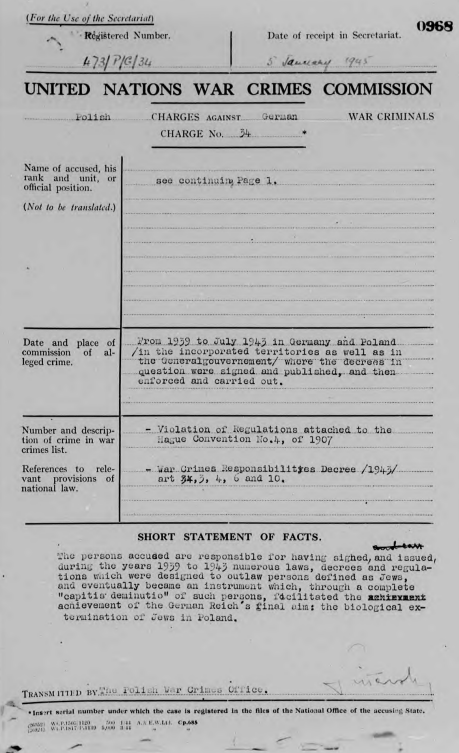
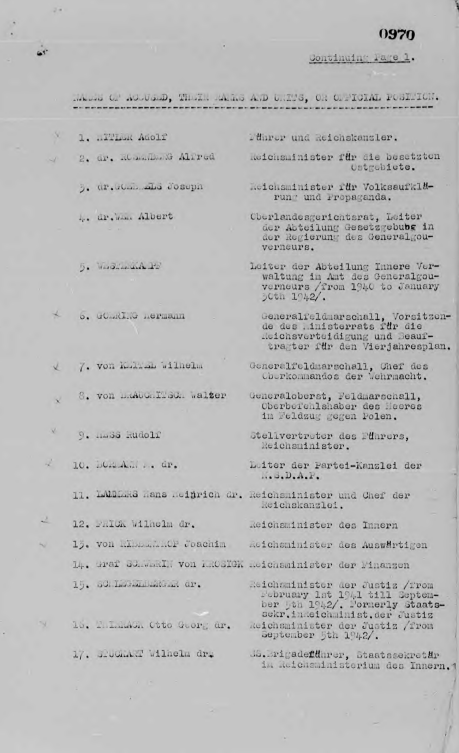
Poland charged Hitler with the “biological extermination of the Jews in Poland,” invoking the Fourth Hague Convention of 1907 and Polish national war crimes decrees.
Belgium brought charges related to atrocities at Auschwitz and Buchenwald under Belgian domestic criminal law.
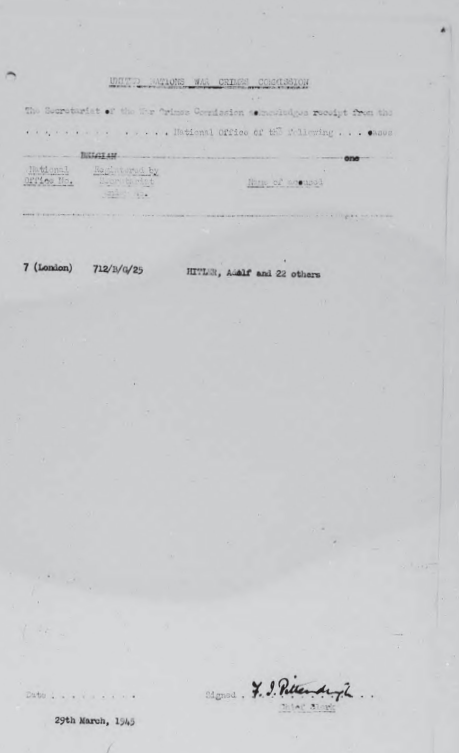
Each indictment was reviewed by the UNWCC’s Committee on Facts and Evidence, which determined they met the prima facie standard for prosecution. Hitler’s name subsequently appeared on official UNWCC lists of war criminals subject to arrest and trial in domestic courts—a sitting head of state formally designated for prosecution by foreign domestic jurisdictions.

The Legal Framework Behind Rejection of Head of State Immunity

The UNWCC’s rejection of head of state immunity was not an ad hoc political decision but a carefully considered legal determination. The Commission appointed a special subcommittee in December 1944, chaired by Lord Wright, to study the question of head of state immunity “in all its details.” After careful analysis of Nazi governmental structures and individual responsibility, the subcommittee reached a clear conclusion.

As documented in the UNWCC’s official History, published in 1948 and representing the collective views of all member states:

“The Commission and its Committee on Facts and Evidence adopted the rule of placing such persons on war crimes lists, and consequently rejected as irrelevant the doctrines of immunity of heads of State and members of Government, and of acts of State. Upon charges presented by various nations, Hitler was placed on the Lists of war criminals on several occasions, and so were other high State administrators, such as Mussolini.”

This finding was based on the Commission’s assessment that meaningful accountability for international crimes required rejection of traditional immunity doctrines. The History explains that if accountability for such grave crimes was to be more than “theoretical, moral, or political condemnation,” it “could be done only by dismissing the doctrine of immunity of heads of state.”

France’s Central Role

France played a foundational role in establishing this precedent. General Charles de Gaulle signed the 1942 St. James Declaration endorsing prosecution of war criminals “whether they have ordered them, perpetrated them or participated in them”—language that explicitly excluded no one based on rank or position. Professor André Gros, representing France at the crucial September 1944 UNWCC meeting, supported Hitler’s inclusion on the war criminals list.

This position built on France’s earlier advocacy following World War I. The 1919 Commission on Responsibilities, to which France contributed two members, adopted a report rejecting head of state immunity, stating that “there is no reason why rank, however exalted, should in any circumstances protect the holder of it from responsibility.” France advanced the position that immunity “depends on whether the sovereign in question conducted himself as a law-abiding and trustworthy chief of state” and that by committing serious violations of international law, “a sovereign loses … any immunity he might claim under international law.”

The Commission’s Reasoning and Contemporary Relevance

The UNWCC’s analysis addressed the evolving nature of international crimes and their impact on traditional immunity concepts. The Commission reasoned that developments in crimes against peace and crimes against humanity “brought about profound alterations in the doctrines of immunity of heads of State” and “individual responsibility of members of Governments and high-ranking administrators.”

The Commission explicitly linked the rejection of immunity to the principle of non-impunity for grave crimes:

“If the proposition that aggressive wars or persecutions on racial, political, or religious grounds in time of war were criminal acts, was not to be confined to the sphere of moral principles … the only way to deal with it was to recognise that individuals upon whose decisions such acts depended were to be held penally responsible. This could be done only by dismissing the doctrine of immunity of heads of state.”

Evidence of Consensus and Legal Authority

The UNWCC’s position reflected not merely the views of a few states but enjoyed broad support within the international community. The Commission’s work was endorsed by sixteen Allied nations representing the major powers and numerous smaller states. The legal authority of this consensus is demonstrated by the subsequent Nuremberg and Tokyo Charters, which explicitly rejected immunity for heads of state and government officials.

Article 7 of the Nuremberg Charter declared: “The official position of defendants, whether as heads of State or responsible officials in Government departments, shall not be considered as freeing them from responsibility or mitigating punishment.” This principle was subsequently incorporated into Control Council Law No. 10 and has influenced international criminal law development ever since. None of the states supporting an international tribunal for prosecution of WWII’s major war criminals considered that such a tribunal was necessary to overcome personal immunity of the troika.

Implications for the al-Assad Case

The rediscovered UNWCC practice should inform the Cour de Cassation’s analysis of immunity in the al-Assad case. Rather than the Arrest Warrant judgment’s finding of no relevant state practice, the evidence reveals extensive, coordinated state practice during the formative period of international law explicitly rejecting head of state immunity for international crimes.

The chemical weapons attacks at Douma and al-Ghouta involved sarin, a nerve agent specifically prohibited under the Chemical Weapons Convention. The systematic nature of these attacks, combined with their targeting of civilian populations, places them squarely within the category of crimes that the international community has determined cannot be shielded by immunity. Reflecting the gravity of these crimes, the UN Security Council (unanimously), UN General Assembly, and OPCW called for all perpetrators of these attacks to be held accountable.

The Path Forward

The Cour de Cassation now faces a choice between perpetuating the incomplete analysis of the Arrest Warrant case or recognizing the full scope of relevant state practice. The WWII foundation demonstrates that even during the 1940s, the international community recognized that certain crimes are of such gravity that traditional immunity concepts cannot shield perpetrators from accountability.

France, as a founding member of the UNWCC and a leader in establishing the principle of accountability over immunity, has the opportunity to place this precedent in its rightful place in international law. By recognizing that head of state immunity cannot protect those responsible for chemical weapons attacks against civilian populations, the court can honor both historical precedent and contemporary legal principles demanding accountability for the gravest crimes.

The question is not whether al-Assad committed the alleged crimes—that determination awaits trial. Rather, it is whether any individual, regardless of position, can claim immunity from prosecution for systematic attacks using prohibited chemical weapons against civilian populations. The answer, established through extensive state practice over seventy years ago but hidden by Cold War politics, remains clear: justice must prevail over impunity.

Categories
Uncategorized

An Important Past: Since Hitler, Heads of State have No Immunity 

The following guest post was written by Prof Dan Plesch for Justice in Conflict.

As a Head of State, Adolf Hitler was indicted for war crimes by several European states in the winter of 1944-45 under their domestic laws as well as international law. The three states, Belgium, Czechoslovakia and Poland were supported by a dozen others, including China, France, the UK and the USA who were all members of the United Nations War Crimes Commission. The legal documents were sealed for decades. When they were finally released in in the 2010s, their significance warranted a news story by the Associated Press in 2017, The documents were not available to the International Court of Justice as it considered the arrest warrant case over a decade earlier.

At a time when many are discussing and debating head of state immunity, the Hitler indictments point the way to further reducing the impunity of national leaders in the twenty first century.

As a historian observing and engaging with the community of International Criminal Law, I find it curious that this state practice has been given no weight by generations of judges, lawyers and scholars. The unanimous view of sixteen leading states that Hitler was personally and functionally liable for the atrocities committed in his name confounds the established view that individual states cannot legally prosecuted the sitting Heads of State of other governments. 

The criminal liability of Heads of State and of Government, as well as Foreign Ministers is a live issue once more with the Paris Court of Appeal’s ruling that French investigating judges could issue an arrest warrant against Syrian President Assad and with the complaints before the Office of the Swiss Attorney General against Israeli President Herzog. For some commentators, these actions contravene the 2002 decision of the International Court of Justice (ICJ) in the Arrest Warrant case, in which the ICJ held that customary international law includes the rule that sitting Heads of State, Heads of Government, and foreign ministers are immune from criminal jurisdiction, including arrest warrants and indictments, by foreign national courts, including for war crimes and crimes against humanity. The ICJ distinguished personal immunity from functional immunity, and distinguished national criminal jurisdiction from international criminal jurisdiction such as the International Criminal Court (ICC)

The long overlooked customary state practice from the 1940s can be seen as contradicting the ICJ judgment and so reinforcing the validity of the Assad and the Herzog cases. The now unsealed documentary record in relation to efforts to prosecute Hitler provides individual and multilateral state practice from the 1940s that set the immunities of Heads of State and Government in a decision of the United Nations War Crimes Commission (UNWCC) and subsequent actions of that body and its members states. Thus, the ICJ overlooked the most important state practice precedent relevant to its inquiry – and in fact the only time prior to 2002 that the world’s most powerful states considered the issue together. 

At a time when many are discussing and debating head of state immunity, the Hitler indictments point the way to further reducing the impunity of national leaders in the twenty first century. More details on these UNWCC-supported charges are now available in recent research into the unsealed archives of this multinational organisation of the mid-1940s. It has been presented in London and The Hague. The International Law Commission has recently received submissions to be considered in its work on the Immunity of State officials from foreign criminal jurisdiction.

In this post, I am presenting the UNWCC and member states practice on the issue, building on my 2017 work, ‘Human Rights After Hitler’, which established that “Hitler was an indicted war criminal at death.

The UNWCC was constituted by sixteen states in 1943 in London and accorded formal diplomatic status by the British government. It records relevant to the immunities issue include legal submissions by member states, Commission minutes and papers, correspondence between the Commission and Member States, and the Peace Treaty between Italy and the Allies in 1947.

In 1944, the UNWCC adopted the rule “discarding as irrelevant the doctrines of immunities of heads of State and members of Government, and acts of State” when providing an advisory opinion that individual states could prosecute Hitler and that therefore the Commission could list him as an accused war criminal subject to arrest by Allied forces. The decision, described in the Commission’s History, was published by the British government in 1948, but has been given scant attention since. This UNWCC decision was made by the sixteen member states after investigations by a sub-Committee led by Lord Wright of Durley, a former senior English judge. The Commission itself was chaired by Sir Cecil Hurst, a member and former President of the Permanent International Court.

This decision of “discarding as irrelevant” Heads of State immunities constitutes significant evidence of customary international law consisting of the advisory opinion of the UNWCC and the opinio juris of its member states and of the judges and experts that represented them. Hitler and his senior officials were then indicted by Czechoslovakia, Poland and Belgium. The Commission considered and approved the charges as meeting a prima facie standard. The UNWCC then listed Hitler and his officials as accused war criminals subject to arrest for trial in the domestic courts of the indicting state. 

At this point, in the winter of 1944-45, the UNWCC was the only institutionalised international legal response to Nazi crimes, as envisaged by the 1923 St James’s declaration and the 1943 Moscow statement on atrocities. The effort that led to the London Charter for the International Military Tribunal at Nuremberg was not yet even an intergovernmental negotiating process. That Hitler died and his Foreign Minister Von Rippentrop was condemned at Nuremburg does not negate the authority of these indictments holding the individuals liable for crimes while they were still in office.

In addition, Gauleiters (Nazi-imposed heads of government of nation states and provinces incorporated into the Reich) were indicted while still in office and later convicted in domestic courts across continental Europe during the period. Prosecutions of Gauleiters endorsed by the UNWCC were made by Czechoslovakia, France, Luxembourg, Norway, Poland and Yugoslavia. All of these states convicted their former Nazi rulers when they were no longer in office but were still regarded as personally liable for their actions as heads of government in particular territories. Some may argue that these men were not Heads of State, at the time that was widely recognised as their role.

Then in 1947, pursuant to the peace treaty between the Allies and Italy, Ethiopia had ten cases against Italian leaders endorsed by the Commission. The peace treaty does not include immunities, not even for Marshal Badoglio, despite the fact that he brokered Italy’s change of side in the war and had then briefly been its Prime Minister. 

Article 45 of the peace treaty required Italy to apprehend and surrender for trial “Persons accused of having committed, ordered or abetted war crimes and crimes against peace or humanity”. The accused included Marshal Badoglio and General Graziani both of whom had been heads of the Italian government of Ethiopia. Charges ranged from the use of poison gas to cultural crimes. 

The peace treaty was signed by all the states that had been at war with Italy, including four members of the newly created UN Security Council. The absence of any provision for immunities and the subsequent international support through the UNWCC for the indictments of two of the heads of government of Ethiopia can be considered as a body of personal customary international criminal liability of former heads of government in keeping with the trials of the former Gauleiters.

The Indictment documents of Hitler along with his high and other officials are provided here. The Commission endorsed indictments against Hitler submitted by Belgium, Czechoslovakia and Poland as having met a prima facie standard for prosecution. The Commission required states to cite both the crimes under domestic and international law. The Commission considered and determined what constituted International Criminal Law in the 1940s and provided the advisory opinion that this included the Hague Conventions and the “Versailles list” prepared by the Commission on Responsibilities in 1919. Often overlooked today, the “Versailles List” was given significant status because Japan had been amongst the allied powers that drew up the list and then it had been accepted by Germany. 

The Czech indictments of Hitler alone cover 11 separate cases amounting to over 600 pages of evidence. Two indictments concerned the illegality of Nazi “courts” as not meeting any minimum standards of justice and not being legal to establish in occupied territory. A rather technical issue on which to indict a Head of State and of Government. Other Czech charges included mass exterminations of Jews, exterminations of villagers close to resistance actions at Lidice, and lists of named individuals. Now familiar names such as Buchenwald and Dachau are the focus of some indictments.

Poland’s focus was the “biological extermination of the Jews in Poland” in violation of the 4th Hague Convention of 1907 and war crimes decrees made by the exiled Polish government in London in 1943. Belgium followed suit with charges concerning Auschwitz and Buchenwald. Belgium also developed charges concerning the murder of prisoners and pillage against Hitler.

The UNWCC-related cases presented here warrant consideration not just by the International Law Commission (ILC) but also of the ICJ. It is curious that the ICJ was not aware of the work of the President of the interwar Permanent Court in leading the UNWCC to set aside considerations of immunity of national leaders given that it had been published officially in 1948. It would be odder still if, now that the original documents are fully available, the ILC and the ICJ did not consider the UNWCC-related cases in their future work. 

It may be that states and other interested parties take up this newfound evidence overturning the notion of absolute functional and personal immunity of Heads of State.  Of course, there are risks of spoiling and frivolous use of the restoration of Head of State criminal liability. But such concerns cannot simply obliterate the cases from the 1940s. If greater legitimacy is sought for bi-lateral indictments, then forms of hybrid pre-trial process – the UNWCC model – and hybrid courts are available. 

One needs to ask why this material was set aside for so long. It is not merely a question of poor research and a failure to challenge an established consensus. The US led a process permitting the Getting Away with Murder(s) with the excuse of rebuilding Germany, as is well documented by now. It may well be that those interested in holding Presidents Assad, Hertzog and Putin to account for their disparate alleged crimes will find this material of specific use.

Categories
Uncategorized

Alderney and the Channel Islands: Evidence from the files of the United Nations War Crimes Commission

Note to Dr Carr, Professor Glees and the Pickles Committee members from Prof. Dan Plesch and Zahraa Kapasi

Links and Extracts from UNWCC files of charges brought to the UNWCC by member states. The charges located so far are:

  • UK vs Germany, 1944. UK/G Case 19, Reel 19, pdf pg 241 onwards

Concerning deportations of the local population of Jersey/Guernsey to Germany based on British official information.

Reel-19-Charge-files-UK-vs-Germans-1-330-1.pdf (unwcc.org)

  • UK vs Germany, 1945. UK/G Case 251, Reel 19, pdf pg 2319 onwards

Charge concerning reductions made in certain rations of foodstuffs for the civilian population of the States of Jersey in reprisal for attacks made by Allied Forces on supply ships bound for the Channel Islands.

Reel-19-Charge-files-UK-vs-Germans-1-330-1.pdf (unwcc.org)

  • Czechoslovakia vs Germans, 1946. Cz/G Case 49, Reel 3, pdf pg 1035 onwards (See Appendix 1)

Concerning crimes in Alderney. Charge based on a file from the British War Crimes Executive. Offenses included murder, including SS guards being rewarded with food and drink for five dead prisoners, and the filling of the sick by means of injections.

Reel-3-Charge-files-Czechslovakia-vs-Germans-1-246-1.pdf (unwcc.org)

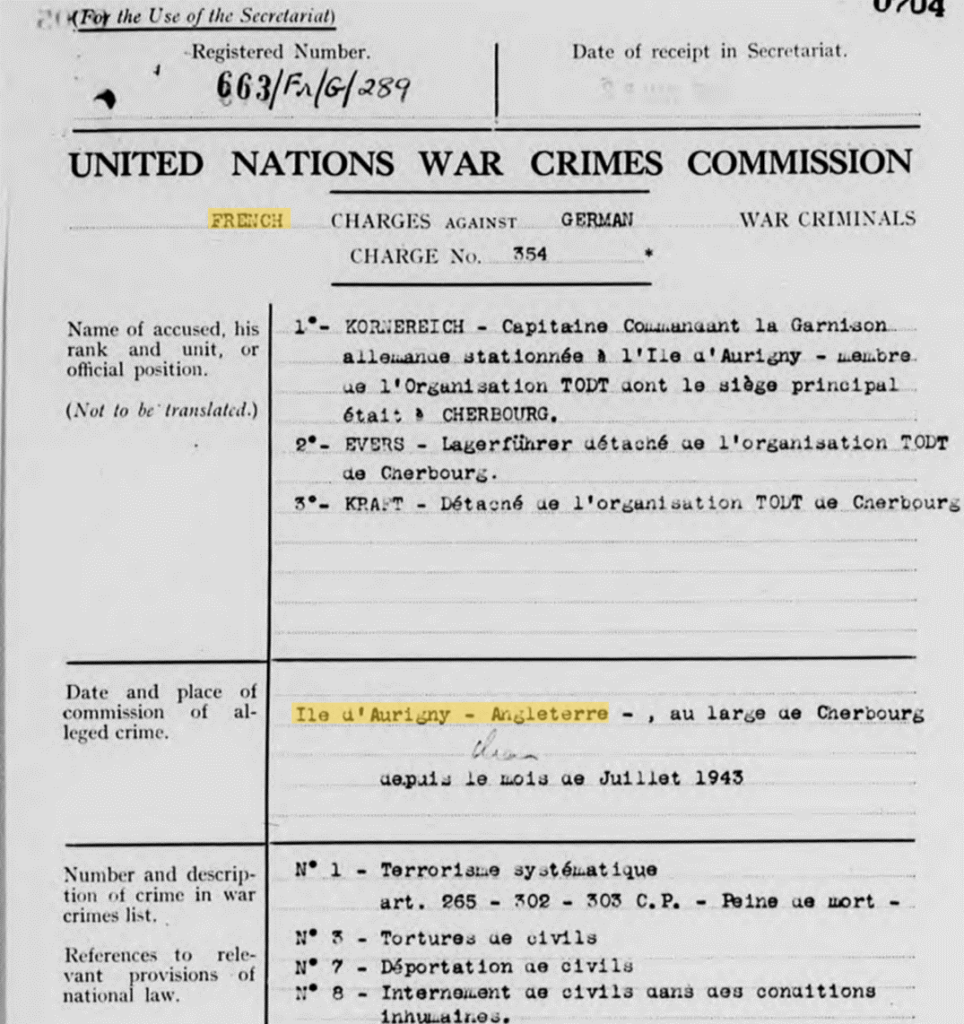
  • France vs Germans, 1946. F/G Case 289, Reel 5, pdf pg 751 onwards (see Appendix 2) & Case 469, pdf pg 1951 onwards (see Appendix 3)

Charge concerning the Mariette prison, the Mariette school in France, and transport of 650 French Jews to Alderney and what happened: “extreme violence against Jewish workers.” Based on evidence retained in France by a Mr Henry Cohen of Paris.

Reel-5-Charge-files-France-vs-Germans-181-520.pdf (unwcc.org)

  • France vs Germans, 1947-48. F/G Case 2171, Reel 10, pdf pg 711 onwards (see Appendix 4)

Primarily concerning the transit of prisoners from Alderney to the continent after D-Day and murders enroute. But also including evidence of murders and other crimes in Alderney. Witness Woitas on pdf pg 722 specifies relating to “Camp Adolf” and transport to the island of 940 prisoners, of whom 650 survived to be transported back to the continent, and of the other 290, 150 “ont ete exterminee est les autres ont ete tu es.” Witness statements are from ex-prisoners and French railway workers.

Reel-10-Charge-files-France-vs-Germans-2061-2231.pdf (unwcc.org)

For background, these documents were officially submitted by the state concerned to the UNWCC. That Commission was hosted, staffed, and chaired by the UK which also took part as a member state in the Commission’s decision on the cases. Commission chairmen included a former President of the International Court of Justice and a former Master of the Rolls. The French cases were signed by Andre Gros, a member of the International Court of Justice, and the Czech case by Bohuslav Ecer, also a judge at the International Court of Justice. As far as it can be seen, so far almost all those charged were put on lists of accused war criminals although some were listed as witnesses.

We have not found related trial reports yet. The archive includes trial reports that are incomplete and do not appear to show the relevant cases. The lack of a trial in normal civil proceedings in no way invalidates the charges. There are many reasons that accused persons never had their day in court and the records of trials that took place were lost and received little media interest. The US and UK suppressed war crimes prosecutions from 1948 as is detailed in David Wilkinson’s acclaimed film “Getting Away with Murder(s)” on Amazon Prime, which is essential background reading. We also suggest Human Rights After Hitler, 2017, Chapter 9, ‘Liberating the Nazis’ by Prof. Dan Plesch.

At the beginning of the archives section of http://www.unwcc.org there is a simple and comprehensive guide to the use of the archive. However, the OCR search technology is not perfect, especially on hard to read texts, and while some search for Aurigny and Alderney has been productive, search for “Channel Islands” and either ‘Iles de la Manche’ or ‘Îles Anglo-Normandes’ has not been conducted fully.

Prof. Dan Plesch

SOAS University of London

Door Tenant, 9 Bedford Row Barristers’ Chambers

Zahraa Kapasi

SOAS University of London

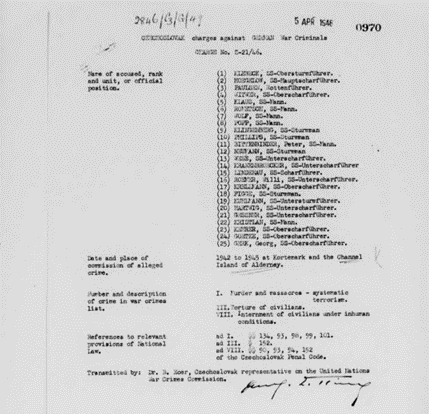
Appendix 1: Cz/G Case 49- Czech trial against German war criminals in Alderney. It lists the accused, including Hoegelow

‘The accused committed inhuman acts, especially atrocities, in the Concentration Camp formed by the “1 SS-Bau Brigade Fuer Das Ausland” on the Channel Island of Alderney and at Kortemark.

The 1 SS-Bau Brigade Fuer das Ausland was formed from inmates of the Concentration Camp Sachsenhausen in September, 1942 and came under the command of the Concentration Camp Harburg-Neuengamme in March, 1943 on the island of Alderney. It was then transferred from Alderney to Kortemark.

The brigade had a total of approximately 1,000 inmates, among them Czechoslovak nationals.’

‘All the accused were responsible for and participated in, the atrocities committed to the prisoners. The prisoners were brutally beaten and inhumanly ill-treated. Many of them were murdered. Ill prisoners were killed by injections.’

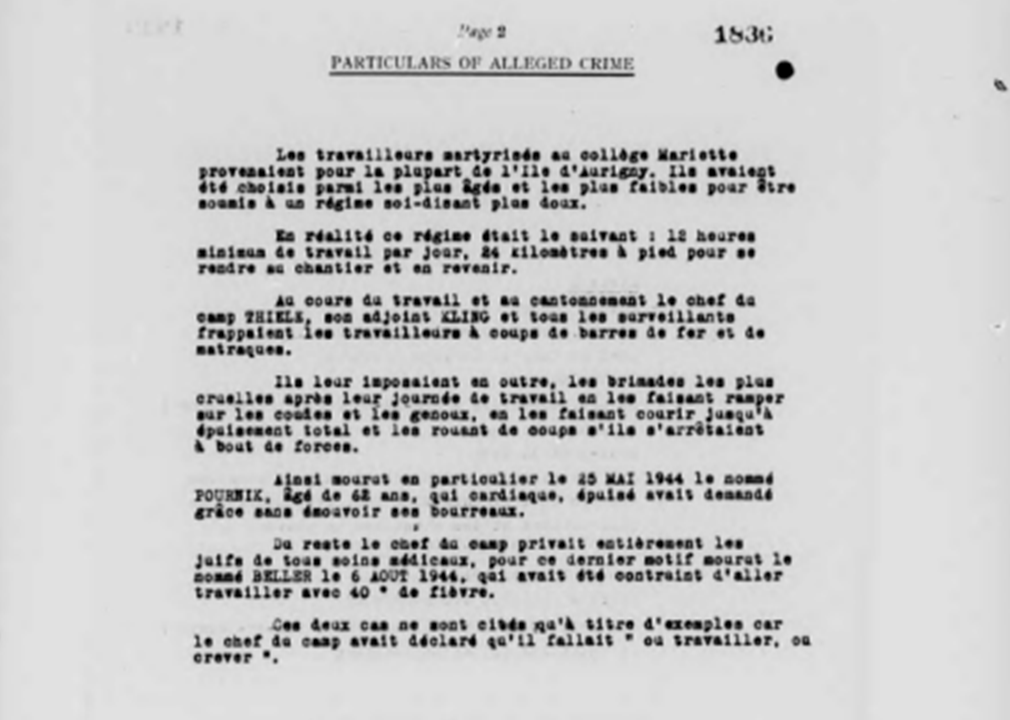
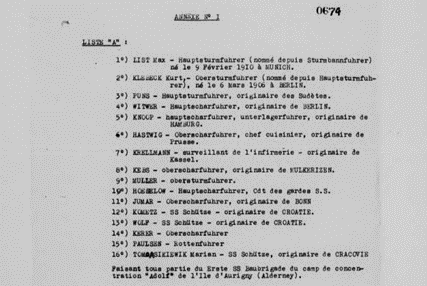
Appendix 2: F/G Case 289- Charge about Mariette including Alderney.

Appendix 3: F/G Case 469- Charge about Mariette including Alderney.

Appendix 4: F/G Case 2171- Case concerns train transport from Alderney. It includes lengthy affidavits and lists the accused.

This case contains multiple pages of evidence with a focus on transport.

p.714

– Refers to 68 wagons of 50 people, with sections of the train headed to different destinations. If they all carried prisoners, this would amount to over 3000 people.

– At Toul, after some Russians try and escape, the train is fired upon by Germans with automatic weapons. 16-17 corpses disposed of beside the tracks.

p.716

– A German train.

p.720

– Evidence of a Dutch witness prisoner concerning his journey through several camps and then to Alderney: ‘…thousand others to Alderney… worked in Blockhaus… 24 June boat to St Malo then train… 18 killed at Toul.’ ‘Scandalous treatment on Alderney.’

p.720-721

– More Dutchmen give evidence about Alderney.

– About 1000 prisoners on the Island of various nationalities.

p.722

– Numbers of prisoners: 940.

-Numbers given for exterminations and killings. Some killed before Toul. About 40 total.

-Protest of German Doctor.

p.728

-Notes decision of UNWCC Committee I.

Categories
Uncategorized

Ending the Immunity of National Leaders for International Crimes

On Wednesday 13th September, Prof. Dan Plesch (SOAS University of London/ 9 Bedford Row), Dr Dominika Uczkiewicz (Pilecki Institute), Dr Amina Adanan (Maynooth University)and Dr Mba Chidi Nmaju as Chair spoke at SOAS University on the implications of new research in the unsealed WW2 indictments of Adolph Hitler and other leaders by Belgium, Czechoslovakia, Ethiopia and Poland, supported by the UN War Crimes Commission.

The issue of the immunity of national leaders remains important in international criminal law and politics. For example, while the ICC has certain jurisdiction and the concept of Universal Jurisdiction opens other opportunities for judicial action, the International Court of Justice ruling against bilateral national prosecutions is restrictive.

New analysis by Uczkiewicz,  Plesch and Adanan of the now unsealed archives of the 1943-1948 UNWCC revealed a previously barely public but, in fact, rich mine of state practice, precedent and multilateral advisory opinions strengthening customary international law, not least in the context of universal jurisdiction.

They presented analysis of  the 700 pages of indictments of Hitler and his entourage, and of the Italian fascist leadership developed by national governments and approved by the 16 nation UNWCC as meeting a prima facie standard. This system of positive complementarity has broader lessons that may be considered.

This seminar was part of the SOAS-led Leverhulme funded project on positive complementarity and is also part of a series of activities marking the first meeting of the UNWCC at the Royal Courts of Justice in London in the autumn of 1943.

You may watch a recording of the event below:

Categories
Uncategorized

Prosecuting the ‘unprosecutable’:Dead end or a way forward?

By Efe Ozkan & Mingma Doma Sherpa

Since passing the one year mark for the start of the war in Ukraine, the conflict has been elevated to a new level – a war lasting years, not an operation lasting days. Accusations of war crimes and misconduct have developed as a political platform calling for persecution and justice against the Russian Federation. In a state like the Russian Federation, the government cooperates on all levels, primarily through the knowledge and orders of Vladimir Putin himself. The question now is, who are these accusations directed against? Do we hold Putin responsible for war crimes because the soldiers were just “following orders”? Prof. Plesch and colleagues have uncovered a relic from the past, available on unwcc.org, that may present an answer.

Unfortunately, this is not the first time the world has witnessed such events. Neither is it the first time that justice has been attempted against the perpetrators of these events. The United Nations War Crimes Commission- the predecessor to the ICC and many other tribunals- was the first international organisation to address the prosecution of war crimes. Thanks to Prof. Plesch and his colleagues, who have uncovered the legal documents surrounding the indictments against Nazis, which were in far greater number than those at Nuremberg, we are one step closer to answering the how of prosecution against Russia and Russians.

The UNWCC documents could be used as a credible source of reference as we navigate through the Russia-Ukraine war to hold the perpetrator/s accountable for the war crimes alongside the debate of the immunities of the head of state. However, Russia being a member of the P5 with the power to veto might bring the entire case to a dead-end. Nevertheless, perhaps Ukraine could be supported much as the UNWCC supported Poland and other states.

The final question here is: is there a practical way to enable prosecutions Will the world be able to find a way forward?

Categories
Uncategorized

Russia’s War of aggression against Ukraine: Challenges in documenting and prosecuting war crimes

Pictured: Jacob Thaler, Natasha Bradley Byrne, Dan Plesch, Dominika Uczkiewicz

Russia’s war of aggression against Ukraine has gone from atrocity to atrocity. Some of the brutalities which have occurred include evidence of torture, mass murder, large scale war crimes and even crimes bearing the hallmarks of genocide. The Pileski Institute in Berlin in cooperation with the Center for Liberal Modernity hosted an international conference Russia’s War of aggression against Ukraine: Challenges in documenting and prosecuting war crimes” between the 1st and 3rd February 2022. The underlying theme addressed across the conference was accountability; What must the world do now to document alleged war crimes and crimes against humanity and hold those responsible for the crimes to account? Members of the UNWCC steering committee attended the conference (pictured above) where Prof. Dan Plesch presented a collaborative paperPrecedents and practice for the Ukraine: The UNWCC indictments of Adolf Hitler, myths of head of state immunity, domestic and International indictments after WWII”. The presentation focused on potential lessons to be drawn from the history of UNWCC charge files and post-World War II indictments for the current debate on head of state immunity.

Categories
Uncategorized

Symposium on the UNWCC: 21st Century Value of the 1943-1948 UN War Crimes Commission

An op-ed by Dr Dan Plesch on the precedent and practice developed by the 1943-1948 UN War Crimes Commission, and how this can be applied in the case of Ukraine today.

Categories
Uncategorized

Early public diplomacy on the Holocaust – the United Nations Review

Through our research into the early UN, we happen across a lot of interesting files that go against conventional historical narratives. The documents of the United Nations Information Organisation – an early public diplomacy body established by the Allies to disseminate their message about the war, and about early human rights ideas – would be one such old largely forgotten archive. In particular, we’ve found an article from the United Nations Review (‘A Monthly Summary of Documents on the Allied Fight for Freedom’), from January 15 1943, detailing a ‘Joint Protest on Jewish Wrongs’. It contains a cross-national, public condemnation of Nazi exterminations efforts, and anti-Jewish persecution more broadly.

This public diplomacy document is being presented by Dan Plesch at the UN Library in Geneva today. It – and documents like it – have been overlooked for 75 years, and details public awareness of the Holocaust as it happened, years before the end of the war, overturning established understanding.

See here for the file!

Categories
Uncategorized

International Bar Association Paper on the UNWCC

publication of the War Crimes Committee by the International Bar Association.

Categories
Uncategorized

Review of Human Rights After Hitler: The Lost History of Prosecuting Axis War Crimes

Human Rights after Hitler: The Lost History of Prosecuting Axis War Crimes has been reviewed on the American Academy of Religion’s online book review website. The review of the book can be found here.